Verified on: September 11, 2026 | Location: Bengaluru, India
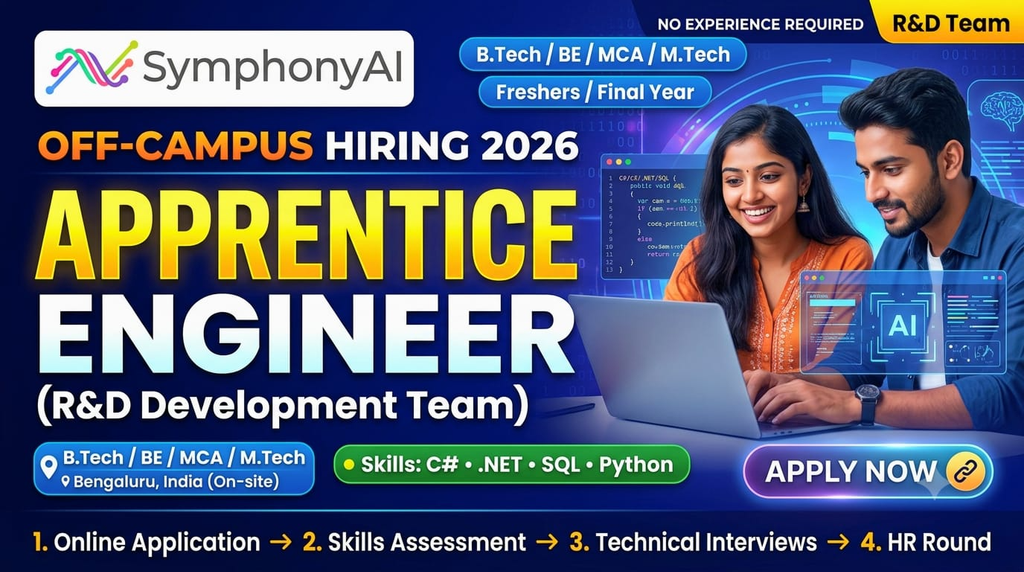
SymphonyAI is hiring Apprentice Engineers for its R&D Development Team in Bengaluru, working on next-generation Category Planning and Retail Analytics platforms. This is a hands-on apprenticeship covering enterprise web applications, cloud-native architecture, and emerging AI/agentic workflows — a strong fit for recent graduates and final-year students who want real product-engineering exposure rather than a purely theoretical internship.
Application Status: Open. The official listing does not show a fixed closing date — verify the live status and apply directly through SymphonyAI’s careers page (link at the bottom of this article) rather than relying on this date.
Job Details
| Company | SymphonyAI |
| Job Title | Apprentice Engineer, R&D Development Team |
| Department | R&D Development |
| Location | Bengaluru, India |
| Eligible Candidates | Recent graduates / final-year students (preferred) |
| Education | Bachelor’s/Master’s in Computer Science, IT, MCA, or Engineering |
| Employment Type | Apprenticeship |
| Application Status | 🟢 Open — verify on official page |
About Symphony AI and This Role
SymphonyAI builds enterprise AI SaaS products for retail, consumer packaged goods, financial crime prevention, manufacturing, media, and IT service management. Founded in 2017, it now serves 1,500+ enterprise customers globally with around 3,000 employees across 30+ countries.
This apprenticeship sits within the R&D Development Team, working on Category Planning and Retail Analytics products — specifically modules like Assortment Optimization, Planogram Automation, Space Analytics, and Category Insights. You’ll work alongside experienced engineers on real product code, not isolated training exercises.
Key Responsibilities
Software Development
- Assist in designing, developing, and enhancing web applications using Angular, JavaScript, TypeScript, and .NET/C#.
- Develop and consume RESTful APIs.
- Write clean, maintainable, scalable code following best practices.
Core Engineering Skills (Must-Have)
- Solid understanding of .NET fundamentals — OOP principles, API development, backend architecture basics.
- Strong debugging and problem-solving ability, including root-cause analysis and code tracing.
- Efficient, optimized SQL queries — joins, aggregations, performance-aware query design.
- Ability to analyze issues across application, API, and database layers.
Data & Cloud Engineering
- Work with Azure (AKS, Functions, Storage), SQL Server, and Snowflake.
- Support data pipelines, transformations, and analytics workflows.
AI & Advanced Capabilities (Good to Have)
- Exposure to Python-based data processing (Pandas, NumPy) and basic ML/GenAI concepts (RAG, LLMs, APIs).
- Assist in building intelligent insights for category planning.
Testing, Debugging & Quality
- Write unit and integration tests.
- Debug, troubleshoot, and tune performance across the stack.
- Identify and resolve issues across frontend, backend, and database layers.
Collaboration
- Work in Agile teams with Product Managers, Architects, and QA.
- Participate in code reviews, sprint planning, and retrospectives.
Eligibility, Explained Simply
In plain terms: if you have (or are finishing) a B.Tech/BE/MCA/M.Tech in Computer Science, IT, or a related engineering field, and you’re comfortable with at least one backend language (C# preferred) plus basic SQL, you’re a realistic fit — even without professional work experience.
- Education: Bachelor’s/Master’s in Computer Science, IT, MCA, or Engineering. Recent graduates or final-year students preferred.
- Core skills expected: C# (preferred), JavaScript, Python; strong .NET fundamentals; debugging and analytical problem-solving (mandatory); SQL with the ability to write complex queries; HTML/CSS/JavaScript basics.
- Preferred but not mandatory: Angular or another modern frontend framework, REST API development, Azure or similar cloud platforms, SQL Server/Snowflake/PostgreSQL.
C#. NET JavaScript Type Script Angular SQLREST APIs Azure Python Debugging Gen AI/LLM (good to have)
Technologies Mentioned in the Job Description
- C#
- NET
- JavaScript
- TypeScript
- Angular
- SQL
- REST APIs
- Azure
- Python
- Debugging & Problem Solving
- GenAI / LLM Concepts (Good to Have)
Ideal Candidate Profile
- Strong problem-solving and analytical mindset.
- Can debug issues independently and think systematically.
- Quick learner, curious about real-world enterprise systems.
- Some full-stack development OR data/ML project experience (academic or personal).
- Basic understanding of APIs, databases, and application workflows.
- Effective communication and teamwork.
Application Checklist
- Confirm your degree matches (CS/IT/MCA/Engineering) and your graduation timeline fits “recent graduate or final-year student.”
- Review your C#/.NET fundamentals — be ready to discuss OOP concepts and basic API design.
- Prepare 2–3 SQL query examples you can explain (joins, aggregations, why you wrote them that way).
- List any Angular, REST API, Azure, or data-platform exposure, even from coursework or personal projects.
- If you’ve touched Python/Pandas or any GenAI/LLM tool, note it — it’s a “good to have,” not mandatory.
- Update your resume with real projects: what you built, what problem it solved, what you’d improve.
- Apply directly through the official SymphonyAI careers page (link below) — avoid third-party job boards claiming to process your application.
- Double-check contact details and keep a copy of your submitted application/confirmation email.
Resume Preparation Guide for This Apprenticeship
This is one of the most useful things you can get right before applying — a well-structured resume matters more than a long one, especially for a role like this that explicitly values debugging ability and hands-on skills over years of experience.
1. Lead With a Focused Summary, Not a Generic Objective
Skip lines like “seeking a challenging position to utilize my skills.” Instead, write two lines that mirror what this role actually needs: e.g., “Final-year Computer Science student with hands-on experience in C#/.NET and SQL, comfortable debugging across application and database layers, and exploring Angular and Azure through academic projects.” This immediately signals fit.
2. Structure Your Skills Section to Match the Job’s Priorities
The listing explicitly separates “must-have” core skills from “good to have” extras. Mirror that structure on your resume:
- Core (list first, prominently): C#, .NET fundamentals, SQL, debugging/problem-solving, HTML/CSS/JavaScript.
- Additional (list after): Angular, REST APIs, Azure, SQL Server/Snowflake, Python, Git/Docker, GenAI/LLM exposure.
Recruiters and applicant-tracking systems both respond well to skills grouped this way — it shows you understood what they’re actually looking for, rather than listing every technology you’ve ever touched.
3. Describe Projects Around Problems Solved, Not Just Tools Used
Avoid: “Built a web application using Angular and .NET.” Instead: “Built a small inventory-tracking web app (Angular + .NET Web API + SQL Server) — the tricky part was optimizing a slow aggregation query, which I fixed by restructuring the joins and adding an index, cutting load time from 4s to under 1s.” This single sentence demonstrates the exact “debugging and analytical problem-solving” skill the listing calls mandatory.
4. Include a Small “Debugging Story” Somewhere
Since debugging is explicitly called out as a core, mandatory skill, add one short bullet — in a project description or a dedicated line — describing a real bug you tracked down and fixed. Interviewers for this kind of role often ask “tell me about a bug you struggled with,” so having this ready in writing and in your head is genuinely useful preparation, not just resume padding.
5. Quantify Where You Honestly Can
Freshers often worry they have “nothing to quantify.” You usually do: number of API endpoints built, size of a dataset processed, percentage improvement in a query’s execution time, number of unit tests written, or even team size in a college group project. Small, honest numbers make a resume noticeably more credible than adjectives like “excellent” or “hardworking.”
6. Keep Formatting Clean and ATS-Friendly
Use a simple, single-column layout, standard fonts, and clear section headings (Education, Skills, Projects, Experience/Internships, Certifications). Avoid text inside images, tables-within-tables, or heavy graphics — many companies’ applicant tracking systems fail to parse these correctly, which can silently drop a genuinely strong application.
7. Match Your Resume Length to Your Experience
One page is usually right for a fresher or final-year student. If you have a few strong internships plus solid academic projects, one and a half to two pages is acceptable — but don’t pad a thin resume to reach two pages; a focused one-pager reads stronger than a stretched two-pager.
8. Prepare to Explain Every Line
Only include a skill or project you can comfortably discuss in an interview. If Azure is listed but you’ve only read about it, be ready to say so honestly rather than overstating — interviewers for engineering-heavy roles like this one usually probe skills listed on the resume directly.
How to Learn These Skills as a Beginner
If you’re starting from scratch or want to strengthen weak spots before applying, here’s a practical order to build the core skills this role expects:
- Learn C# fundamentals — variables, data types, control flow, and basic syntax. Free resources like Microsoft Learn’s C# path are enough to start.
- Learn OOP concepts — classes, objects, inheritance, polymorphism, encapsulation, interfaces. Practice explaining each with a simple real-world example.
- Practice SQL queries — start with SELECT/JOIN/GROUP BY, then move to subqueries and query optimization (indexes, execution plans).
- Build a simple CRUD project — a basic app (e.g., a to-do list or inventory tracker) using .NET + SQL Server. This single project touches almost every “must-have” skill in this listing.
- Learn REST APIs — how HTTP methods (GET/POST/PUT/DELETE) map to CRUD operations, and how to consume an API from a frontend.
- Learn Git & GitHub — commits, branches, pull requests. Even solo projects benefit from proper version control habits.
- Learn Azure basics — just enough to deploy a small app or use Azure Storage/Functions. You don’t need deep cloud expertise, just working familiarity.
Interview Preparation Guide
Based on the core skills this role emphasizes, expect interview questions from these areas — prepare a few clear, spoken explanations (not just written notes) for each:
- OOP concepts — be ready to explain inheritance vs. composition, and when you’d use an interface vs. an abstract class.
- C# basics — value types vs. reference types, exception handling, collections.
- SQL queries — write a join or aggregation query on a whiteboard/shared doc without an IDE’s autocomplete.
- API concepts — REST principles, status codes, how you’d design a simple endpoint.
- Debugging scenarios — walk through how you’d approach a bug report with no clear reproduction steps.
- Agile basics — what a sprint, standup, and retrospective are for, even if you’ve only seen them in a college project.
Sample 30-Day Preparation Plan
A focused, four-week plan to prepare if you’re starting from a moderate base:
Week 1: Foundations
- C# syntax and fundamentals
- Core OOP concepts, with small practice examples
Week 2: Data & APIs
- SQL queries — joins, aggregations, basic optimization
- REST API concepts and building/consuming a simple API
Week 3: Frontend & Debugging
- Angular basics (components, data binding)
- Deliberate debugging practice — introduce bugs into your own code and fix them
Week 4: Projects, Resume & Mock Interviews
- Finish and polish your CRUD project
- Update your resume using the guide above
- Do 2–3 mock interviews (peers, mentors, or self-recorded) covering the topics above
Related Career Guides
- Resume Preparation for Freshers: A Complete Guide with Real Interview Examples
- Interview Preparation Guide for Freshers
- SQL Interview Questions for Beginners
- C# Beginner Roadmap
Common Mistakes to Avoid
- Listing every technology you’ve heard of. This role separates must-have from good-to-have skills for a reason — an unfocused resume works against you here.
- Ignoring the SQL requirement. Several core responsibilities (query optimization, cross-layer debugging) depend directly on SQL comfort — don’t skip preparing this because you’re stronger in frontend work.
- Overstating GenAI/LLM experience. It’s explicitly a “good to have,” not a core requirement — don’t let it overshadow weaker fundamentals in C#/.NET or SQL.
- Applying through unofficial/third-party links. Use only SymphonyAI’s official careers page.
- Submitting a resume with no real projects. Academic or personal projects are fine — recruiters expect them at this level — but vague descriptions without specifics undercut them.
- Assuming a fixed stipend/CTC. The listing does not specify compensation — don’t rely on unofficial numbers from third-party sites.
Frequently Asked Questions
What is the role?
Apprentice Engineer, R&D Development Team, working on Category Planning and Retail Analytics platforms at SymphonyAI, Bengaluru.
Who can apply?
Recent graduates or final-year students with a Bachelor’s/Master’s in Computer Science, IT, MCA, or Engineering.
Which skills are mandatory vs. good to have?
Mandatory: C# (preferred), JavaScript, Python basics, strong .NET fundamentals, debugging/problem-solving, SQL, HTML/CSS/JS. Good to have: Angular, REST API depth, Azure/cloud, SQL Server/Snowflake, GenAI/LLM exposure.
Is prior work experience required?
No — this is an apprenticeship aimed at recent graduates and final-year students. Academic or personal projects are an acceptable substitute for professional experience.
Is the salary/stipend mentioned?
No, the listing does not specify compensation. Confirm this directly during the official hiring process.
What is the application deadline?
No fixed deadline is shown in the listing. Check the official SymphonyAI careers page for the current status before applying.
How can I apply?
Through SymphonyAI’s official careers page — see the Apply link below.
Ready to Apply?
Apply directly through SymphonyAI’s official careers listing for this Apprentice Engineer role.Apply Now – SymphonyAI Careers
Update History
- September 11, 2026 (revised): Fixed a technology-list formatting issue, and added a beginner learning roadmap, interview preparation guide, 30-day preparation plan, and related career guide links.
- September 11, 2026: Article published with eligibility summary, application checklist, resume preparation guide, and common mistakes based on the official job description.
Disclaimer: LCJP Job Hub provides job information for educational and informational purposes. We organize publicly available recruitment information to help job seekers. Job details, eligibility criteria, application status, and compensation may change at any time. Always verify the latest information on the official SymphonyAI careers website before applying. LCJP Job Hub does not guarantee employment, selection, interview calls, or recruitment by any company mentioned on this website, and is not the recruiting company.
Also Read
The Interview Mistake I Made as a Fresher — And How I Fixed It (My Real Experience) Read This
Resume Preparation for Freshers: A Complete Guide with Real Interview Examples Read This
Microsoft Software Engineer Jobs 2026 in Hyderabad – Apply Online