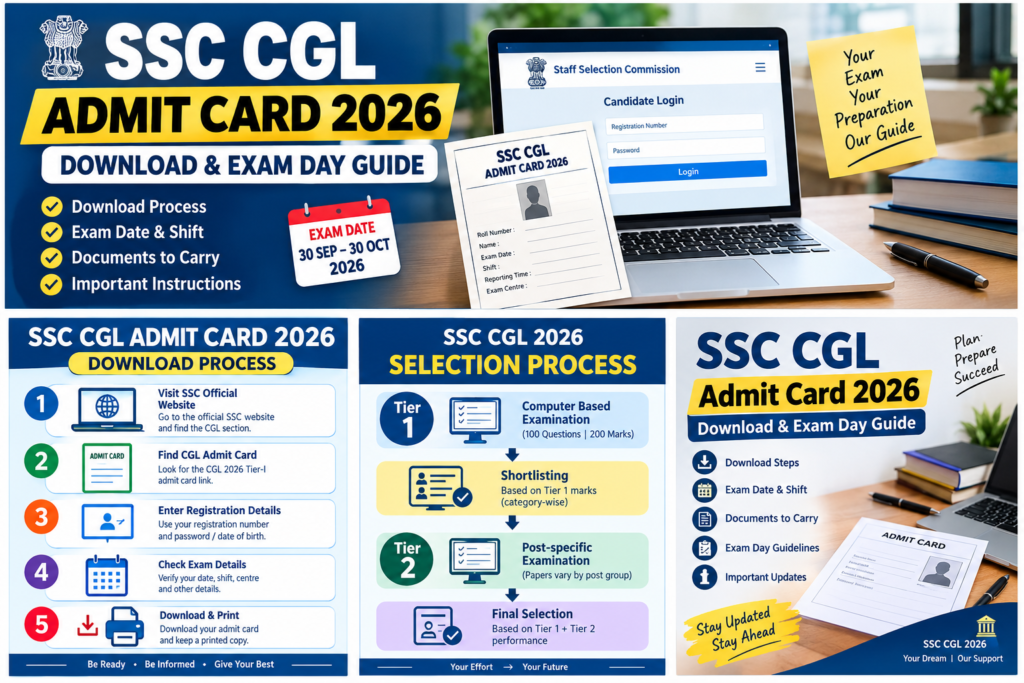
SSC CGL Admit Card 2026: Explained, With Examples
SSC is releasing the CGL Tier 1 admit card for 2026 in stages, not all at once, and that single fact trips up more candidates than almost anything else about it. This guide explains why the download link might look unavailable even though the admit card is officially out, walks through every field worth double-checking on the hall ticket, and works through what your shift timing actually means for your morning — with worked examples at each step. StatusReleasing nowStaggered by each candidate’s own exam date ExamSSC CGL Tier 1, 2026 Vacancies10,731 (Group B & C posts) Exam window30 September – 30 October 2026 Download hereSSC’s official website Last verified27 September 2026
In this guide
- Why it might not show yet
- What Tier 1 decides
- After Tier 1
- How to download it
- Reading your admit card
- Shift timings, explained
- Documents to carry
- Exam day guidelines
- If something’s wrong
- Common mistakes
- Quick answers
- Update history
Why it might not show up yet
SSC’s own update makes this explicit: the admit card is live only for candidates whose Tier 1 exam falls on 30 September. Tier 1 for this cycle runs a full month, from 30 September to 30 October, across roughly 29 lakh applicants — releasing every admit card on a single day isn’t how SSC has staged an exam window this size, and the pattern across SSC and Railway exams this year has been to open each batch a few days ahead of that batch’s own exam date. Example
If your exam date is 30 September, you can try downloading right now. If your date turns out to be, say, 14 October, an unavailable link this week isn’t a fault on your end — check back three to four days before your own date instead of refreshing daily from today.
What Tier 1 actually decides
CGL runs across four tiers, and it helps to know where this one sits. Tier 1 is a single computer-based screening paper — the one this admit card is for — and it exists mainly to narrow 29 lakh applicants down to a shortlist for Tier 2, where the harder, post-specific papers happen. Because Tier 1 runs across a full month in multiple shifts, SSC normalises the raw scores afterward so a tougher shift on 15 October isn’t a disadvantage next to an easier one on 2 October. None of that changes how you should prepare — score as high as you can — but it explains why one shift’s paper can feel noticeably different from another’s without anyone being shortchanged.
Tier 2 itself later splits into different papers depending on the post group you’re being considered for — a Data Entry Operator’s paper looks nothing like an Assistant Section Officer’s — but that split happens after Tier 1, based on your result and post preferences. Right now, all 29 lakh Tier 1 candidates sit the exact same single paper, covering general intelligence, general awareness, quantitative aptitude and English; nothing post-specific comes into play at this stage.
What happens after Tier 1
Tier 1 alone doesn’t decide your post — it decides whether you move forward at all. SSC first releases a Tier 1 answer key and gives candidates a short window to raise objections against it, for a small fee per question challenged, then publishes results and a merit list of who’s shortlisted for Tier 2. That gap between the last Tier 1 shift and the Tier 2 result has typically run to a few months in past cycles, so it helps to treat this as the start of a longer process rather than a one-day event. Example
A candidate who sits Tier 1 on 5 October shouldn’t expect a result that same week — the exam keeps running for other candidates until 30 October, and SSC typically waits until every shift across every date is complete, and normalisation finished, before publishing one combined result.
How to download it, step by step
- Go to ssc.gov.inUse the official site only — SSC hall tickets are never emailed or posted to candidates.
- Find the Tier 1 admit card noticeIt’s linked from the “Admit Card” section on the homepage, worded along the lines of status or download admit card for Tier 1 of CGL 2026.
- Enter your Registration ID and date of birthThe same two details you used while filling the application — not your Aadhaar number or a newly chosen password.
- Confirm your exam city or areaThe one you selected during registration; it can’t be changed at this stage.
- Download and printSave a digital copy too, but print a physical one — a printed copy is what SSC’s own guidance asks candidates to carry.
Example
A frequent login failure has nothing to do with the admit card itself: candidates type their date of birth in the wrong order. If your registration used DD-MM-YYYY and the form keeps rejecting a correct-looking date, re-enter it the way SSC’s form expects rather than however your phone’s calendar defaults to it.
Reading your admit card: what each field means
Your hall ticket packs about a dozen details onto one page, and they fall into two groups worth treating differently.
Identity details — name, date of birth, category, gender, photograph and signature — need to broadly match your other documents, not match character for character. A name printed as “Ravi Kumar” when your Aadhaar reads “Ravi Kumar Reddy” is a common, low-risk mismatch. A wrong category, on the other hand — General printed where you applied under OBC, say — is worth emailing your regional SSC office about before exam day, since it can affect how your result is processed later.
Logistics details — roll number, registration number, exam date, shift, reporting time, and the exam centre’s name and address — are what actually get you into the hall. Write your roll number down somewhere separate from the printout itself; a smudged or torn corner on exam morning is a bad time to be squinting at a barely legible number.
The instructions section at the bottom is easy to skim past, but SSC sometimes adds a cycle-specific rule there — a dress-code note or a newly banned item — that won’t be in any generic guide, this one included. Read it once, properly.
Shift timings, and what they mean for your morning
| Shift | Reporting | Exam starts | Exam ends |
|---|---|---|---|
| Shift 1 | 7:45–8:30 am | 9:00 am | 10:00 am |
| Shift 2 | 10:30–11:15 am | 11:45 am | 12:45 pm |
| Shift 3 | 1:15–2:00 pm | 2:30 pm | 3:30 pm |
| Shift 4 | 4:00–4:45 pm | 5:15 pm | 6:15 pm |
Your admit card names one of these four. Work backward from the reporting time, not the exam start time — gates typically stop admitting candidates once the reporting window closes, so arriving at “exam start” is already too late. Example
A candidate assigned Shift 3, reporting 1:15–2:00 pm, at a centre in an unfamiliar part of their city, should treat 1:00 pm as their real deadline to be near the gate, not 1:15. That leaves room for finding the right building, a security queue, and the walk from the road to the hall itself — all before the reporting window shuts.
Documents to carry
SSC’s list of acceptable photo ID is longer than most candidates assume: Aadhaar, voter ID, passport, driving licence, PAN, a government-recognised college or school ID, a government service ID, or an ex-servicemen discharge book all count. Example
What trips candidates up isn’t the list — it’s the condition of the ID. A driving licence that expired last month, or a college ID with no photograph on it, is a common reason someone gets held up at the gate. If your primary ID is close to its expiry date, carry a second one from the list as backup, and bring two passport-size photographs in case the centre asks for one at verification.
Your ID also needs to look like you look now. A photo taken several years ago, before a noticeable change in appearance, can slow down verification even on an otherwise valid document — carrying a second, more recent photo ID alongside an older one helps if you’re not sure which way yours leans.
Exam day guidelines, explained
Most of SSC’s exam-day rules are self-explanatory — printed admit card, valid photo ID, no phones or smartwatches, light clothing without metallic accessories. Two are worth explaining rather than just listing.
Reaching 45–60 minutes before reporting time isn’t padding added in for safety; large centres process hundreds of candidates through document checks and frisking in that window alone, and a queue that looks short from the road can still take twenty minutes to clear.
Visiting your exam centre the day before matters more than it sounds like it should, especially if it’s in a part of your city — or a different city altogether — that you don’t know well. Discovering on exam morning that the map pin is off, or that the building has three gates and only one is open, is avoidable with a five-minute visit the evening before.
The ban on phones, smartwatches and earphones isn’t only about preventing cheating in the room itself — most centres don’t allow these devices inside the building at all, and few offer secure storage for them. Bringing one just creates a problem before you’ve reached your seat; leave it at home, or with someone waiting outside, rather than assuming the centre will hold it for you.
If something’s wrong: who to call
SSC handles CGL through nine regional offices, not one central helpline, and calling the wrong one usually just means being redirected. Match your exam centre’s state to the region below.
| Region | States covered | Helpline |
|---|---|---|
| Northern (NR) | Delhi, Rajasthan, Uttarakhand | 011-24363343 |
| Central (CR) | Uttar Pradesh, Bihar | 0532-2460511 |
| Eastern (ER) | West Bengal, Odisha, Jharkhand, A&N Islands, Sikkim | 033-22902230 |
| Western (WR) | Maharashtra, Gujarat, Goa | 022-22019118 |
| Southern (SR) | Andhra Pradesh, Tamil Nadu, Telangana, Puducherry | 044-28251139 |
| Karnataka Kerala (KKR) | Karnataka, Kerala, Lakshadweep | 080-25502520 |
| North Eastern (NER) | Assam, Arunachal Pradesh, Manipur, Meghalaya, Mizoram, Nagaland, Tripura | 0361-2642770 |
| North Western (NWR) | Chandigarh, Punjab, Haryana, Himachal Pradesh, J&K, Ladakh | 0172-2744366 |
| Madhya Pradesh (MPR) | Madhya Pradesh, Chhattisgarh | 0771-2423676 |
Example
A candidate whose centre is in Hyderabad or Warangal falls under the Southern Region, reached through its Chennai-based number — not the Delhi-based Northern Region a quick search might surface first.
Common mistakes to avoid
- Refreshing the download page daily from today even though your own exam date is weeks away — check a few days before your date instead.
- Treating every mismatch the same way — a slight name spelling difference rarely matters, but a genuine category or gender error needs reporting before exam day.
- Carrying only a phone screenshot of the admit card instead of a printed copy.
- Skipping a visit to an unfamiliar exam centre the day before.
- Calling a different region’s helpline than the one your exam centre actually falls under.
- Assuming Tier 1 alone decides your post — it only decides whether you’re shortlisted for Tier 2, where post-specific selection actually happens.
Quick answers
I can’t find my admit card yet — is something wrong with my application?
Probably not. Check whether your exam date has arrived, or is within a few days — SSC has been releasing this batch’s admit cards on a rolling basis tied to each candidate’s date, not all at once.
Can I carry a soft copy on my phone instead of printing it?
SSC’s own guidance says to carry a printed copy. Treat that as the rule to follow, not an optional extra, even if you’ve heard of someone getting through with just a screenshot elsewhere.
My admit card shows the wrong exam centre city — what now?
Contact your regional SSC office (see above) before your exam date, with your registration details ready. This isn’t something to raise for the first time at the gate.
Does normalisation mean I’m only compared against my own shift?
No — it’s the opposite. Normalisation adjusts each shift’s raw scores onto one common scale first, specifically so candidates across every shift and date can then be ranked together on a single merit list, rather than kept apart.
Update history
| Date | Update |
|---|---|
| 27 September 2026 | First published, based on SSC’s own admit-card notice for the current CGL 2026 Tier 1 cycle. |
This guide is an independent explanation for jobseekers, not an official SSC document. Release timing and instructions can change, so confirm current details on SSC’s own website before your exam.